
Switches · Enterprise
Enterprise Campus Switch Core
ECS-Core€4,499 excl. VAT
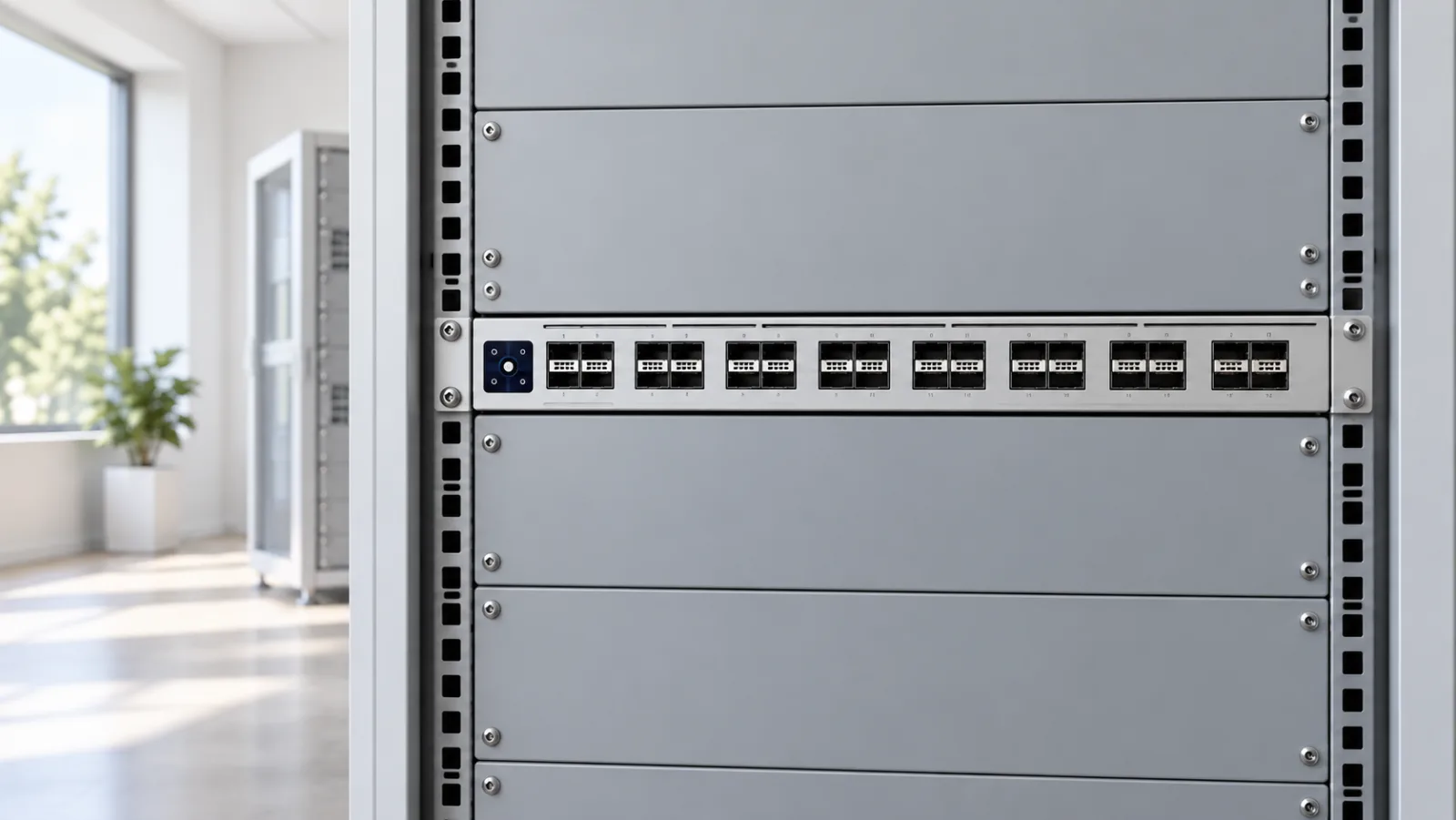
Enterprise Campus Switch Core is a Layer 3 switch for a 19-inch rack, built as the core switch of a larger network, with QSFP28 ports and a touchscreen on the front.
Who it suits
Suits large organisations and campus networks where many switches in different rooms or buildings are gathered in one shared network room or server room. Its ports are made for links between switches and servers, so access points, cameras and computers sit on switches further out in the network. The ports need modules or DAC cables, and the power supplies and fan modules can be replaced while it runs. It is managed from UniFi Network, so the network needs a UniFi gateway or another host for the application.
At a glance
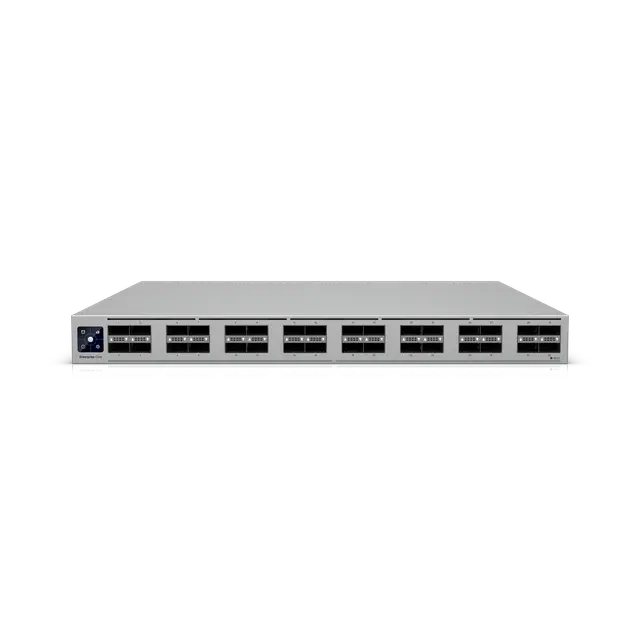
- Number of ports
- 32
- Function level
- Layer 3
- Mounting
- Rack (1U)
- Redundant power
- Two hot-swappable power supplies
Good to know
- MC-LAG requires pairing with a second Enterprise Campus Core switch.
- The QSFP28 ports (100G/40G) do not support breakout cables.
- For four-post racks. Two-post racks need a center-mount bracket or cantilever shelf for optimal support.
Price from Ubiquiti’s EU store, 2026-10-16
In the box
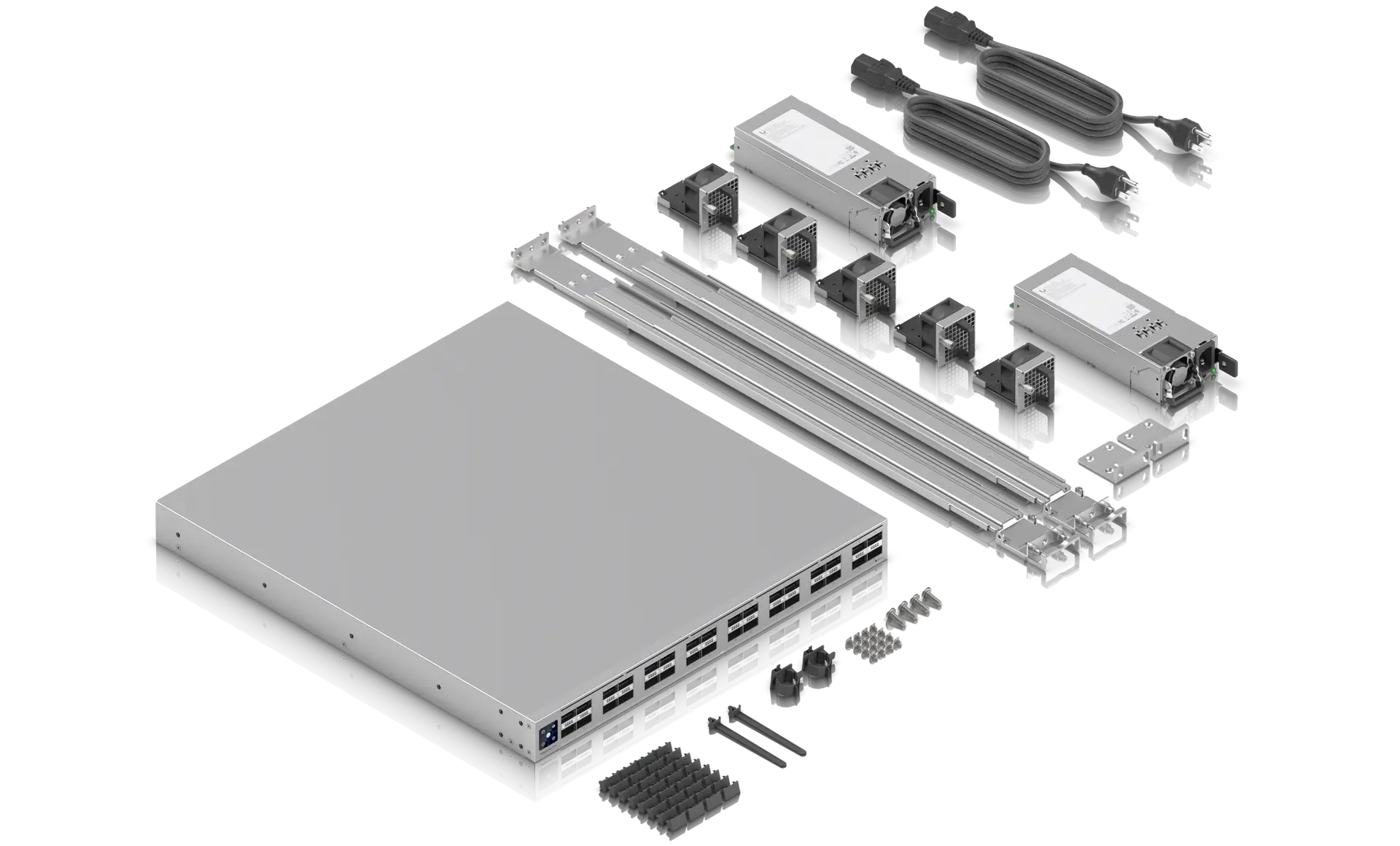
- Enterprise Campus Switch Core
- 2 × Power supply unit
- 2 × Power cable
- 5 × Fan module
- Rail kit
- 2 × Rack ears
- 2 × Cable ties
Specifications
| Overview | |
|---|---|
| Price (excl. VAT) | €4,499 |
| Function level | Layer 3 |
| Ports and PoE | |
| Ports | 1 × 1 Gbps RJ45 (management port) 32 × 100 Gbps QSFP28 |
| Number of ports | 32 |
| PoE ports | – |
| Strongest PoE | – |
| PoE budget | – |
| Performance | |
| Switching capacity | 6,400 Gbps |
| Forwarding rate | 2,800 Mpps |
| VLANs | 1,000 |
| MAC table | 128,000 |
| Features | |
| Layer 3 routing | Yes |
| STP and RSTP | Yes |
| Loop protection | Yes |
| IGMP snooping | Yes |
| 802.1X | No |
| IP-based ACLs | Yes |
| DHCP snooping | Yes |
| Link aggregation (LACP) | Yes |
| Stacking | No |
| MC-LAG | Yes |
| Pro AV profiles | No |
| Etherlighting | Yes |
| Power and redundancy | |
| Power supply | Power cord (C13) |
| Redundant power | Two hot-swappable power supplies |
| Hot-swappable power supplies | 2 × 550 W |
| Max power draw | 360 W |
| Hardware | |
| Display | 1.3" touchscreen |
| Cooling | Hot-swappable fans |
| Physical | |
| Mounting | Rack (1U) |
| Dimensions | 442.4 × 43.7 × 480 mm |
| Weight | 9.7 kg |
| Operating temperature | -5 to 40 °C |
Prices in euros excluding VAT from Ubiquiti’s EU store, fetched 2026-10-16. The store may add a temporary surcharge for memory costs of about 10%.
“Not specified” means that neither Ubiquiti nor the sources we use state the value. “–” means it does not apply to the product.
Sources
Specifications come from Ubiquiti’s technical datasheets, the price from Ubiquiti’s EU store and routing throughput from ui.com.
Show all sources (2)
Details such as chipset, RAM type and cooling come from these sources:
Ubiquiti
- eu.store.ui.com – In the box; Hot-swappable power supplies
- techspecs.ui.com – Hot-swappable power supplies; notes
Compare with other Switches
Showing 9 of 51 products34 of 34 featuresSwipe sideways to see more models.
| Feature | Enterprise Campus Switch CoreEnterprise | 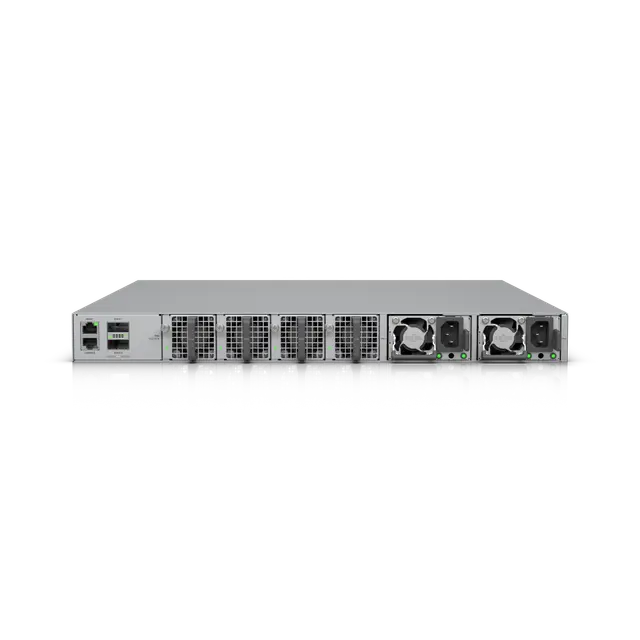 Switch Enterprise Campus 24SEnterprise Switch Enterprise Campus 24SEnterprise | 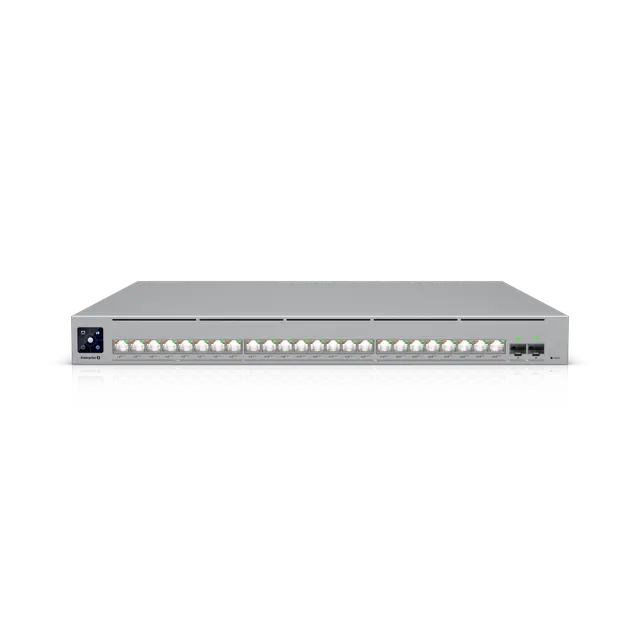 Switch Enterprise Campus 24 PoEEnterprise Switch Enterprise Campus 24 PoEEnterprise | 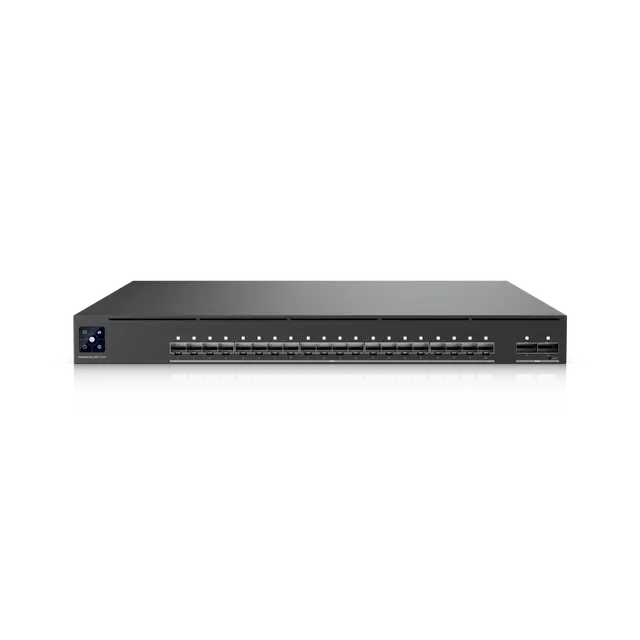 Switch Enterprise Audio/Video FiberEnterprise Switch Enterprise Audio/Video FiberEnterprise | 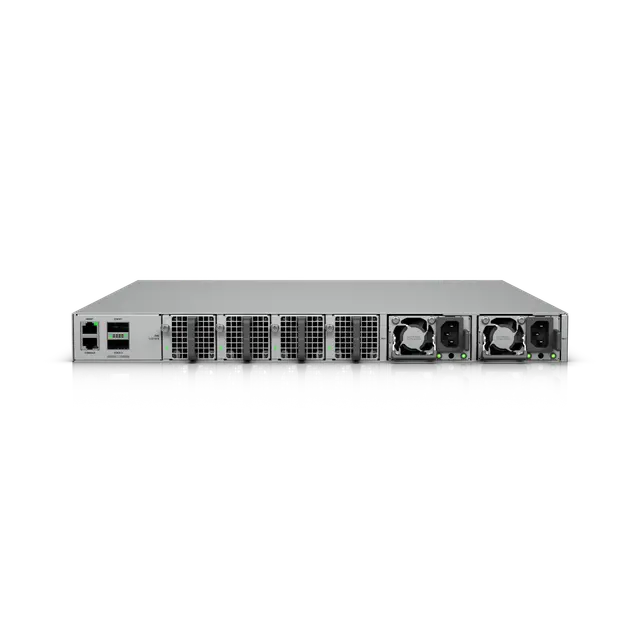 Switch Enterprise Campus 24S PoEEnterprise Switch Enterprise Campus 24S PoEEnterprise | 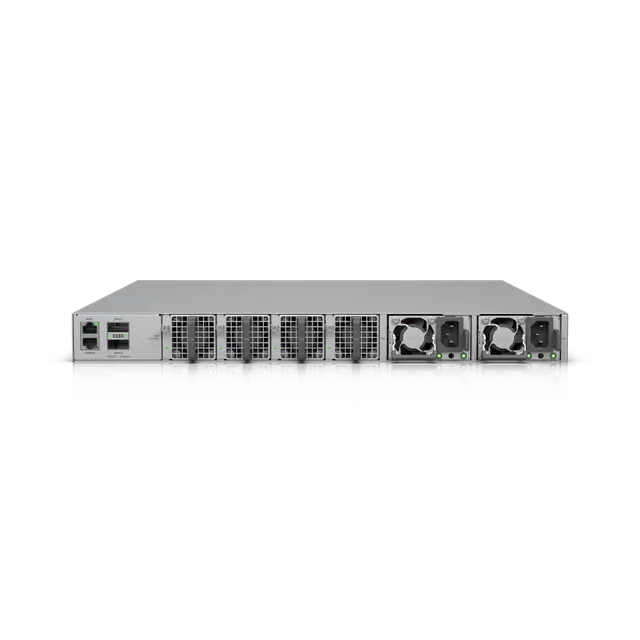 Switch Enterprise Campus 48SEnterprise Switch Enterprise Campus 48SEnterprise |  Switch Enterprise Campus 48 PoEEnterprise Switch Enterprise Campus 48 PoEEnterprise |  Switch Enterprise Audio/Video XG 24 PoEEnterprise Switch Enterprise Audio/Video XG 24 PoEEnterprise | 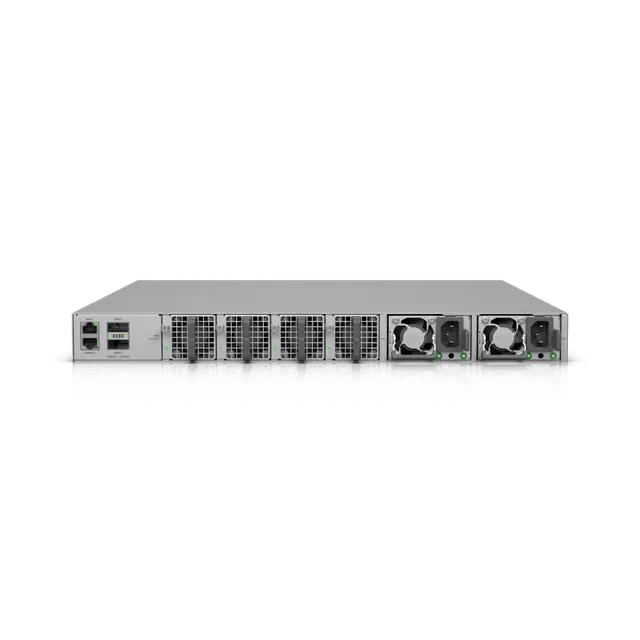 Switch Enterprise Campus 48S PoEEnterprise Switch Enterprise Campus 48S PoEEnterprise |
|---|---|---|---|---|---|---|---|---|---|
| Overview | |||||||||
| Price (excl. VAT) | €4,499 | €1,799 | €2,249 | €2,699 | €2,699 | €2,699 | €3,149 | €3,599 | €3,599 |
| Function level | Layer 3 | Layer 3 | Layer 3 | Layer 3 | Layer 3 | Layer 3 | Layer 3 | Layer 3 | Layer 3 |
| Ports and PoE | |||||||||
| Ports | 1 × 1 Gbps RJ45 (management port) 32 × 100 Gbps QSFP28 | 1 × 1 Gbps RJ45 (management port) 8 × 2.5 Gbps RJ45 16 × 10 Gbps RJ45 4 × 25 Gbps SFP28 2 × 100 Gbps QSFP28 (stacking only) | 8 × 2.5 Gbps RJ45 (PoE+++) 16 × 10 Gbps RJ45 (PoE+++) 2 × 25 Gbps SFP28 | 1 × 1 Gbps RJ45 20 × 10 Gbps SFP+ 2 × 100 Gbps QSFP28 | 1 × 1 Gbps RJ45 (management port) 8 × 2.5 Gbps RJ45 (PoE+++) 16 × 10 Gbps RJ45 (PoE+++) 4 × 25 Gbps SFP28 2 × 100 Gbps QSFP28 (stacking only) | 1 × 1 Gbps RJ45 (management port) 32 × 2.5 Gbps RJ45 16 × 10 Gbps RJ45 4 × 25 Gbps SFP28 2 × 100 Gbps QSFP28 (stacking only) | 16 × 2.5 Gbps RJ45 (PoE+++) 32 × 10 Gbps RJ45 (PoE+++) 4 × 25 Gbps SFP28 | 1 × 1 Gbps RJ45 24 × 10 Gbps RJ45 (PoE+++) 4 × 100 Gbps QSFP28 | 1 × 1 Gbps RJ45 (management port) 32 × 2.5 Gbps RJ45 (PoE+++) 16 × 10 Gbps RJ45 (PoE+++) 4 × 25 Gbps SFP28 2 × 100 Gbps QSFP28 (stacking only) |
| Number of ports | 32 | 28 | 26 | 23 | 28 | 52 | 52 | 29 | 52 |
| PoE ports | – | – | 24 | – | 24 | – | 48 | 24 | 48 |
| Strongest PoE | – | – | PoE+++ | – | PoE+++ | – | PoE+++ | PoE+++ | PoE+++ |
| PoE budget | – | – | 1,050 W | – | 1,050 W | – | 2,150 W | 2,150 W | 2,150 W |
| Performance | |||||||||
| Switching capacity | 6,400 Gbps | 460 Gbps | 460 Gbps | 800 Gbps | 460 Gbps | 680 Gbps | 920 Gbps | 1,280 Gbps | 680 Gbps |
| Forwarding rate | 2,800 Mpps | 342 Mpps | 342 Mpps | 595 Mpps | 342 Mpps | 506 Mpps | 684 Mpps | 810 Mpps | 506 Mpps |
| VLANs | 1,000 | 1,000 | 1,000 | 1,000 | 1,000 | 1,000 | 1,000 | 1,000 | 1,000 |
| MAC table | 128,000 | 32,000 | 32,000 | 32,000 | 32,000 | 32,000 | 32,000 | 32,000 | 32,000 |
| Features | |||||||||
| Layer 3 routing | Yes | Yes | Yes | Yes | Yes | Yes | Yes | Yes | Yes |
| STP and RSTP | Yes | Yes | Yes | Yes | Yes | Yes | Yes | Yes | Yes |
| Loop protection | Yes | Yes | Yes | Yes | Yes | Yes | Yes | Yes | Yes |
| IGMP snooping | Yes | Yes | Yes | Yes | Yes | Yes | Yes | Yes | Yes |
| 802.1X | No | Yes | Yes | Yes | Yes | Yes | Yes | Yes | Yes |
| IP-based ACLs | Yes | Yes | Yes | Yes | Yes | Yes | Yes | Yes | Yes |
| DHCP snooping | Yes | Yes | Yes | Yes | Yes | Yes | Yes | Yes | Yes |
| Link aggregation (LACP) | Yes | Yes | Yes | Yes | Yes | Yes | Yes | Yes | Yes |
| Stacking | No | Yes | No | No | Yes | Yes | No | No | Yes |
| MC-LAG | Yes | No | No | No | No | No | No | No | No |
| Pro AV profiles | No | Yes | Yes | Yes | Yes | Yes | Yes | Yes | Yes |
| Etherlighting | Yes | Yes | Yes | Yes | Yes | Yes | Yes | Yes | Yes |
| Power and redundancy | |||||||||
| Power supply | Power cord (C13) | Power cord (C13) | Power cord (C13) | Power cord (C13) | Power cord (C13) | Power cord (C13) | Power cord (C13) | Power cord (C13) | Power cord (C13) |
| Redundant power | Two hot-swappable power supplies | Two hot-swappable power supplies | Two hot-swappable power supplies | Two hot-swappable power supplies | Two hot-swappable power supplies | Two hot-swappable power supplies | Two hot-swappable power supplies | Two hot-swappable power supplies | Two hot-swappable power supplies |
| Hot-swappable power supplies | 2 × 550 W | 2 × 550 W | 2 × 600 W 1,200 W: UACC-PSU-54V-1200W-EU | 2 × 150 W | 2 × 600 W 1,200 W: UACC-PSU-54V-1200W-EU | 2 × 550 W | 2 × 1,200 W | 2 × 1,200 W | 2 × 1,200 W |
| Max power draw | 360 W | 150 W | 150 W (excl. PoE) | 150 W | 150 W (excl. PoE) | 250 W | 250 W (excl. PoE) | 150 W (excl. PoE) | 250 W (excl. PoE) |
| Hardware | |||||||||
| Display | 1.3" touchscreen | 1.3" touchscreen | 1.3" touchscreen | 1.3" touchscreen | 1.3" touchscreen | 1.3" touchscreen | 1.3" touchscreen | 1.3" touchscreen | 1.3" touchscreen |
| Cooling | Hot-swappable fans | Hot-swappable fans | Hot-swappable fans | Hot-swappable fans | Hot-swappable fans | Hot-swappable fans | Hot-swappable fans | Hot-swappable fans | Hot-swappable fans |
| Physical | |||||||||
| Mounting | Rack (1U) | Rack (1U) | Rack (1U) | Rack (1U) | Rack (1U) | Rack (1U) | Rack (1U) | Rack (1U) | Rack (1U) |
| Dimensions | 442.4 × 43.7 × 480 mm | 442.4 × 44 × 496 mm | 442.4 × 43.7 × 496 mm | 442.4 × 480 × 43.7 mm | 442.4 × 44 × 496 mm | 442.4 × 44 × 496 mm | 442.4 × 43.7 × 496 mm | 442.4 × 480 × 43.7 mm | 442.4 × 44 × 496 mm |
| Weight | 9.7 kg | 9.6 kg | 9.46 kg | 8.95 kg | 9.2 kg | 10.2 kg | 9.46 kg | 9.85 kg | 9.5 kg |
| Operating temperature | -5 to 40 °C | -5 to 40 °C | -5 to 40 °C | -5 to 40 °C | -5 to 40 °C | -5 to 40 °C | -5 to 40 °C | -5 to 40 °C | -5 to 40 °C |
| Good to know | |||||||||
| Notes | MC-LAG requires pairing with a second Enterprise Campus Core switch. The QSFP28 ports (100G/40G) do not support breakout cables. For four-post racks. Two-post racks need a center-mount bracket or cantilever shelf for optimal support. | Up to four switches can be stacked, and only switches with the same port count. A link aggregation can span the switches in a stack, with up to eight ports per LAG. Has no PoE output, so access points and other PoE devices need a PoE switch or a PoE injector. For four-post racks. Two-post racks need a center-mount bracket or cantilever shelf for optimal support. | The 1,050 W PoE budget is shared across the 24 PoE+++ ports (up to 90 W per port), so not every port can deliver full power at once. In redundant power mode, where one module can take over for the other, the budget is 450 W. For four-post racks. Two-post racks need a center-mount bracket or cantilever shelf for optimal support. | Supports PTP time synchronization (IEEE 1588 PTPv2) with hardware timestamping on all Ethernet and QSFP28 ports, as grandmaster, boundary clock or transparent clock. PTPv2 is not supported over aggregated ports. The SMA port takes a GPS signal for grandmaster clock mode. The GNSS antenna (UACC-GNSS-Antenna) is not included and is sold separately. For four-post racks. Two-post racks need a center-mount bracket or cantilever shelf for optimal support. | Up to four switches can be stacked, and only switches with the same port count. A link aggregation can span the switches in a stack, with up to eight ports per LAG. The 1,050 W PoE budget is shared across the 24 PoE+++ ports (up to 90 W per port), so not every port can deliver full power at once. In redundant power mode, where one module can take over for the other, the budget is 450 W. For four-post racks. Two-post racks need a center-mount bracket or cantilever shelf for optimal support. | Up to four switches can be stacked, and only switches with the same port count. A link aggregation can span the switches in a stack, with up to eight ports per LAG. Has no PoE output, so access points and other PoE devices need a PoE switch or a PoE injector. For four-post racks. Two-post racks need a center-mount bracket or cantilever shelf for optimal support. | The 2,150 W PoE budget (at 200–240 V mains) is shared across the 48 PoE+++ ports (up to 90 W per port), so not every port can deliver full power at once. In redundant power mode, where one module can take over for the other, the budget is 950 W. For four-post racks. Two-post racks need a center-mount bracket or cantilever shelf for optimal support. | Supports PTP time synchronization (IEEE 1588 PTPv2) with hardware timestamping on all Ethernet and QSFP28 ports, as grandmaster, boundary clock or transparent clock. PTPv2 is not supported over aggregated ports. The SMA port takes a GPS signal for grandmaster clock mode. The GNSS antenna (UACC-GNSS-Antenna) is not included and is sold separately. The 2,150 W PoE budget (at 200–240 V mains) is shared across the 24 PoE+++ ports (up to 90 W per port), so not every port can deliver full power at once. In redundant power mode, where one module can take over for the other, the budget is 1,050 W. | Up to four switches can be stacked, and only switches with the same port count. A link aggregation can span the switches in a stack, with up to eight ports per LAG. The 2,150 W PoE budget (at 200–240 V mains) is shared across the 48 PoE+++ ports (up to 90 W per port), so not every port can deliver full power at once. In redundant power mode, where one module can take over for the other, the budget is 950 W. For four-post racks. Two-post racks need a center-mount bracket or cantilever shelf for optimal support. |
Prices in euros excluding VAT from Ubiquiti’s EU store, fetched 2026-10-16. The store may add a temporary surcharge for memory costs of about 10%.
“Not specified” means that neither Ubiquiti nor the sources we use state the value. “–” means it does not apply to the product.
Read more
Choosing a UniFi switch: managed, PoE and loop protection
What sets a managed switch apart from an unmanaged one, why loop protection and STP matter, and how to choose ports and PoE for a home or an office.
Switches
Every UniFi switch, from the Flex Mini to rack switches with hot-swappable power supplies. Filter by ports, PoE and features.
Compare switches →